
The benefits of going Solar translates to REAL cost savings and the Government of Guyana has started to reap the benefits. What are YOU waiting for? All our Solar Power Systems are designed so that you recover your costs in approximately 4 years.
Taken from the Guyana Chronicle ->
$488M saved with solar panels on gov’t buildings – CEO of the Guyana Energy Agency
THE integration of solar energy systems on government buildings has resulted in $488M in annual savings, and more than 6,000 tons of reduced annual carbon dioxide emissions, according to Chief Executive Officer (CEO) of the Guyana Energy Agency (GEA), Dr. Mahendra Sharma.
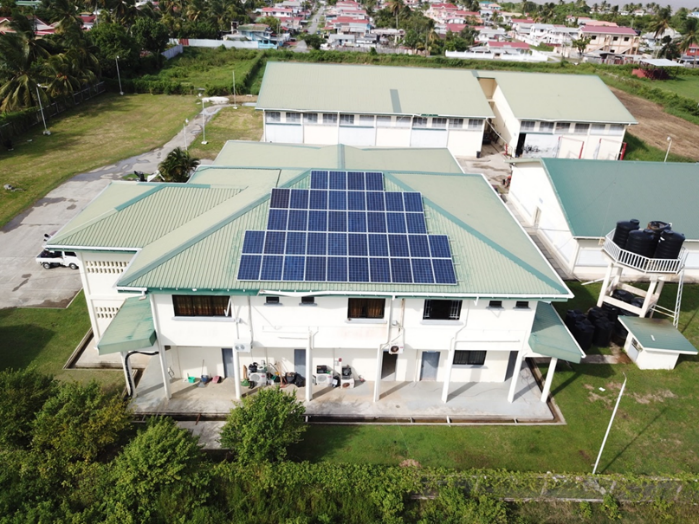
While speaking at a recent virtual forum titled: “Renewable Energy and Guyana: Opportunities for Investment”, which was organised by the American Chamber of Commerce (AmCham), Dr. Sharma noted that, over the past seven years, the GEA facilitated the installation of more than five megawatts (MW) of new solar panels on 291 government buildings. Following the installation, it was found that $488M had been garnered in annual savings.
He explained that the solar energy systems installed were connected to the national grid supply. Through this system, the panel would capture energy from the sun and that energy goes into the grid-tied inverter, which utilises the solar energy and energy from the power grid to power the building it is installed on.
Some of the buildings powered by this mechanism include the Ministry of Education in Region Three (Essequibo Islands-West Demerara), the Leonora Fire Station in Region Three, the National Insurance Scheme in Anna Regina in Region Two (Pomeroon-Supenaam), the Golden Grove Secondary school in Region Four (Demerara-Mahaica) and the Bartica Hospital in Region Seven (Cuyuni-Mazaruni).
The cost saved through the use of these solar-powered systems was in keeping with the GEA’s mandate, Dr. Sharma highlighted. Additionally, he related, “Over the years, we’ve been tendering projects and what we’ve seen is a gradual reduction in the cost.”
He noted that the first national 400-kilowatt (kW) solar photovoltaic (PV) farm was recently completed at Mabaruma, Region One (Barima-Waini. Efforts were underway to establish similar solar farms in Bartica, Mahdia, Lethem and Leguan.
In fact, the CEO highlighted that the solar farms at Bartica and Lethem have already been tendered and those projects are likely to be completed by the end of this year, if there are no major issues. Meanwhile, the solar farms at Mahdia and at Leguan, will be tendered this year.
NEW PROJECTS
“In the next three years, we will be installing seven new solar farms and 10 new solar mini grids, installing more than 39 MW of new solar power in the form of farms and mini grids,” Dr. Sharma highlighted, too.
These solar projects are expected to provide energy to communities across the country, to add to the ongoing works being done to integrate solar technologies into the energy mix. Already, solar-powered street lights have been installed in hinterland areas.
These works add to the separate hinterland electrification project, which is expected to provide energy to some 30,000 houses in rural and hinterland regions. Recently, Indian High Commissioner to Guyana, Dr. K. J. Srinivasa, highlighted that approval for the US$10 million line-of-credit that will be used for the electrification project geared at providing self-dependent solar power to the 30,000 houses was expected to come on stream soon.
Dr. Srinivasa noted that once approval is granted, the High Commission will work with the local authorities to start the process with the Exim Bank of India for the pre-qualification of the project. After that process is completed, it is expected that Guyana would be able to work on the procurement of the equipment needed for the project.
President, Dr. Irfaan Ali, during his address to launch the month-long Amerindian Heritage observances in September 2020, had said that the US$10M would be reprogrammed towards reintroducing solar panels, and the One Laptop per Family (OLPF) programmes in Amerindian villages across the country. Beyond this project, President Ali recently noted that plans are afoot to make Guyana a major energy player and, possibly, the energy capital of the region, through the utilisation of an energy mix of solar, wind, hydro and natural gas.
The integration of those energy sources will provide Guyana with 400 MW of newly installed power. As it is now, the national grid is providing 120 MW of electricity, an amount which is equal to the consumer demand of 117-120 MW of power. In tandem with the President’s focus, Dr. Sharma highlighted that the GEA is also undertaking several hydropower initiatives, in various region. Already, a 20KW hydropower project has been completed in Hosororo, in Region One.
Now, the GEA will be constructing a 150 KW hydropower project in Kato, Region Eight (Potaro-Siparuni). This project, according to the CEO, should be completed in the first quarter of 2022. Shortly, tenders will be put out for similar projects in Moco-Moco and Kumu, both in Region Nine (Upper Takutu-Upper Essequibo).
Meanwhile, at the AmCham forum, Director of Industrial Energy at the The Energy and Resources Institute (TERI), Dr. G Rudra Narsimha Rao, emphasised that a large potential exists in Guyana’s renewable energy sector.
Key areas for development, according to him, include: large scale cogeneration potential across sugar and rice industries; fuel ethanol for blending gasoline, large scale hydro power projects for the expansion and the growth; solar PV project to strengthen the grid; industrial roof solar PV projects, and rice-husk- based power generation projects.
https://guyanachronicle.com/2021/04/04/488m-saved-with-solar-panels-on-govt-buildings/
 Solar Direct Guyana